
The Magnificent Seven – Hard-Earned Sales Wisdom from the Front Lines

By Patrick McClure, Senior Consultant, Lighthouse Consulting Partners LLC

After spending five decades of my life in Sales, I’ve decided to pass the torch to the coming generations with my best wishes for their success. During my long career as a salesperson, sales executive, manager, VP of Sales, author, professional speaker, and consultant I’ve compiled a large number of “lessons learned,” and it is my hope that some of these will translate well into the AI-enabled, multimedia-saturated complexity of today’s sales world.

I was told over a decade ago by a well-known and respected sales luminary that our profession (sales) was becoming increasingly obsolete and would no longer be needed in the coming years. Happily, I have found this statement was incorrect. Even though the selling environment has radically changed, there will always be a need for professional salespeople. I firmly believe that there will never be a time when machine learning, generative AI, and process automation will entirely replace my profession. Fingers crossed!

For this newsletter, I have carefully chosen my Top Seven Best and most Powerful lessons. Every single lesson has generated millions in revenue and profitability for individuals and corporations across the globe. Conversely, failure to follow these simple precepts has invariably resulted in disaster and massive lost revenue. Heed them well, for these are the Magnificent Seven!

The Magnificent Seven

  1. Attitude is Everything

Having the correct attitude before you pick up the phone, write that memo, record a video or podcast, or make a sales call is critical.  Eliminate your internal negative “mind trash”, focus on the Here and the Now and be grateful for everything, especially the opportunity to help others. Put a smile on your face and a bounce to your step and be happy!

  1. Ask Questions and LISTEN

Don’t rush into things prematurely. Stop selling and start listening. Until you KNOW where your prospect is coming from, until you develop empathy with them and appreciate their challenges and opportunities, you have no business trying to sell them anything. Ask questions, be interested, and learn their world!

  1. Sell Value, Not Product

Potential customers don’t want to hear endless details about your product or service. They only care about what is valuable to them, not you. Find out what’s important in their world and if you listen, they will tell you.  Once you understand them, you’ll be able to connect with them more effectively, and you will have earned their attention. People buy when they are convinced the value is worth it!

  1. Handle their Objections

During the selling process, you will frequently encounter a wide variety of objections. Never ignore these tell-tale buying signs, always dive in and handle them promptly. First listen and understand their concern, then deal with it effectively. A seasoned salesperson is an expert at handling objections!

  1. Keep it Simple

Don’t confuse your customers or prospects with complicated explanations and technical “jargon.” If you can’t explain it so clearly that an 8-year-old could understand, don’t bring it up! Practice your most relevant selling points until they are unique, compelling, and extremely easy to understand. Simple sells!

  1. Close Deals

Your job is to finalize the transaction, and to persuade your prospect or customer to move forward with the sale. Everyone else on your team is helping, assisting, and supporting but you are the closer.  People love to buy, and your job is to make it possible for them to say yes, because they really want and need your product. The most skilled salespeople build terrific rapport and trust, selling value all the way, so that customers insist on buying from them!

  1. Don’t Give Up

It has been proven by years of research that 90% of salespeople give up after encountering significant objections. Most rookies give up after hearing 3-4 “no’s”, but it turns out they gave up too early! The majority of sales occur after these “no’s” have been overcome. If your product is a good match for the prospect, if it will sincerely benefit them, if it is truly valuable to them, you owe it to them to complete the sale.

Sales is not simply about persuasion—it’s about connection, value, resilience, and service. The tools may change, but the human essence of this work remains. So, to all the rising stars out there: honor the craft, master the fundamentals, and never underestimate the power of a well-timed question, a sincere attitude, or a persistent heart. The future is yours—go sell it with excellence.

Lighthouse Consulting Partners, LLC

Testing Division provides a variety of talent management services, including in-depth work style personality assessments for new hires, staff development and team building. Lighthouse provides these assessments  in 19 different languages along with offering skills testing, leadership and management coaching and offer a variety of workshops including team building and interview skills.

Business Consulting for Higher Productivity Division provides professional coaching, stress management workshops, sales and customer service training, negotiation skills, leadership training, staff planning, operations, and much more.

For more information on our services, please go to www.lighthouseconsulting.com or contact us at Info@LighthouseConsulting.com.

Permission is needed from Lighthouse Consulting Partners, LLC to reproduce any portion provided in this article. © 2025


The Future of Sales

By Dana Borowka, MA

Not all sales and marketing people are created equal. In a challenging economy, you want to hire people who are creative, image001innovative and can get results despite the roadblocks. After all, today is a new day with new opportunities for those that are open to them. To improve hiring decisions, many companies have found out how to crack the personality code by using robust in-depth work style personality testing. Work style assessments are a standard recruiting practice for many branches of the government and military, as well as many Fortune 500 companies when assessing potential hires for key or critical positions.

Our research for our book, Cracking the Personality Code, reveals that this is not guesswork or an untested science. Here are eight proven ways to use in-depth work style personality testing to hire the right sales and marketing people who are willing to fight for market share.

1. Compare Their Resume Against Your Job Description

Sounds obvious, doesn’t it? Surprising how easy it is to blow right past this step in the hiring process. Past experience alone is not what you are looking for when you review the resume. You are looking at how well they performed, what were their successes, and how adaptable they might be to the job that needs to be done for your organization. Experience is nice, but it is results that really count.

2. Assess Their Problem-Solving Resources

Is this person a problem solver? If so, what kind of problem solver? Each of us has unique problem-solving resources on which we rely. You will want to determine what the person’s strengths are when it comes to problem solving. What are the usual approaches this person will use to resolve these problems?

3. Determine Their Patterns For Coping With Stress

Stress is a force that tends to distort the body, a factor that induces bodily or mental tension, or an automatic physical reaction to a danger or demand in the environment. As one physician stated, “Stress is any demand, either internal, external or both, that causes us to mentally and physically readjust in order to maintain a sense of balance within our life.”

Without a doubt, stress is a fact of life in today’s work world. So determining a candidate’s or employee’s ability to cope with stress is critical for a manager.

4. Examine Their Interpersonal Interaction Styles

Breakdowns in communication are never good for an organization. So take a good look at the individual’s style for relating and communicating with others. How do they usually react in dealing with others? What is their comfort level in interacting and personal connection with others? Personality assessments can tell you the person’s major sources of gratification and satisfaction when building relationships with each other.

This is the time to identify potential red flags. A personality assessment can discover issues that are sometimes overlooked during the traditional interviewing process and can quantifybizman opening door a hunch or feeling the interviewer may have about a particular candidate. Knowing interpersonal interaction styles can also help understand how to manage individuals for greater work performance. A comparison of the interpersonal dynamics of teams, departments, employees and candidates is well worth the effort.

5. Analyze Career Activity Interests

Certain personality tests help you gain information which may either support the person’s present career choices or assist them to explore, consider and plan for another career direction. This is not to say you will be recommending another career choice to someone you are considering hiring or currently managing. Rather, you are using this information to determine fit. All organizations want to ensure that they have the right people in the right positions and effectively distribute these human assets and talents.

6. Assess How They Respond To Tests

You should also use tests with scales for what is known as “impression management.” This is necessary in order to understand the accuracy of results and whether someone is trying to “fake good” or misrepresent themselves. A critical element in predicting a potential candidate’s success is measuring real personality and style in an interview. An in-depth work style and personality assessment presents a fairly accurate picture of a candidate’s personality, work style and fit within a company’s culture.

If a profile does not have an impression management scale, then it is difficult to tell how accurate the data is. A profile needs to have at least 165 questions in order to gather enough data for this scale.  Otherwise you will have no idea of the picture you are getting from an assessment.

7. Chronicle Strengths & Weakness Ledger

Benjamin Franklin reportedly had a decision-making process when he was faced with important challenges. Franklin divided a sheet of paper into two columns, and on the left side listed the reasons for doing something and on the right side the reasons against. Much like a bank ledger with credits and debits, this simple tool greatly aided the analysis of information. Often a quick scan of the two lists gave him the information he needed to make the right choice.

We recommend you do the same for the personality of a job candidate or an employee under your supervision. Like a bank ledger, every credit should have a corresponding debit. That is because for every strength a person possesses there is a corresponding weakness. Being assertive is a strength; however, that personality can be too assertive and off putting for some people they deal with.

8. Create Personality Probing Interview Questions

So, what have you learned about the job candidate so far through personality assessments? What remains to learn? To find out, developinterview questions that probe facets of the personality you need more details on

pen on bookForget those old standby questions like, ‘Tell me about your strengths and weaknesses’. Instead, let’s say you wanted to determine how they cope with stress. You might ask the candidate to give an example of when they made a terrible mistake and how they handled it. Ask them how they think others perceive them when they are under stress. For making a mistake, did they blame others or take responsibility for the outcome? Listen for their process. Do they ask for help? Watch body language and tone of voice to see how much insecurity the candidate expresses at the idea of making a mistake or having stress..

As consultants trained in psychology, this is something we help our clients create for new candidates. To help you create questions, here are some preliminary interview questions for a candidate. Naturally, these are not meant to be questions to ask all candidates, but are indicative of the types of questions you might ask:

What process do you think helps you to learn? Give an example of how you learn a very complex system or skill and what your process was?

How would you handle a situation that brought up many different changes? How do you like to see change take place? Give an example when change was implemented and it just didn’t work out.

Have you ever worked with individuals who are abstract thinkers? How did you deal with that kind of thought process?

Give an example of when you have had to make an exception to the guidelines or rules. How have you handled that?

What was the most challenging sales situation you have ever faced and won? Give an example of when you lost a sale and what you could have done differently.

Whew, seems like a lot to worry about. As with any business decision, having and organizing the right information is critical. Work style and personality assessment testing can key in door lockprovide insight into potential hires, as well as the current workforce. The trick is to gather the information and then look at it in an organized fashion.


If you would like additional information on this topic or others, please contact your Human Resources department or Lighthouse Consulting Services LLC, Santa Monica, CA 90403, (310) 453-6556, dana@lighthouseconsulting.com & our website: www.lighthouseconsulting.com

Dana Borowka, MA, CEO of Lighthouse Consulting Services, LLC and his organization constantly remain focused on their mission statement – “To bring effective insight to your business”. They do this through the use of in-depth work style & personality assessments to raise the hiring bar so companies select the right people to reduce hiring and management errors. LCS can test in 19 different languages, provide domestic and international interpersonal coaching and offer a variety of workshops – team building, interpersonal communication, stress & time management, sales & customer service training and negotiation skills as well as our full-service Business Consulting Division. Dana has over 30 years of business consulting experience and is a nationally renowned speaker, radio and TV personality on many topics. He is the co-author of the books, “Cracking the Personality Code”, “Cracking the Business Code” and “Cracking the High-Performance Team Code”. To order the books, please visit www.lighthouseconsulting.com.

Lighthouse Consulting Services, LLC Divisions

Testing Division provides a variety of services, including in-depth work style & personality assessments for new hires & staff development. LCS can test in 19 different languages, skills testing, domestic and international interpersonal coaching and offer a variety of workshops – team building, interpersonal communication.

Business Consulting for Higher Productivity Division provides stress & time management workshops, sales & customer service training and negotiation skills, leadership training, market research, staff planning, operations, ERP/MRP selection and implementation, refining a remote work force, M&A including due diligence – success planning – value creation and much more.

Permission is needed from Lighthouse Consulting Services to reproduce any portion provided in this article. © 2024

Charting your Sales Course for 2025!

By Patrick McClure, Sr. Consultant

It’s common in the fall time to hear company executives complain about the holiday season. I can just hear them now:

“OMG, we only have two weeks in December, and the rest of the month is a waste of time. No one will be at their desks, and we won’t be able to sell anything!”

“Everyone has visions of sugarplums dancing in their heads, and all they’re thinking about is what presents to buy for their loved ones. How in the world can we get them to focus on MC900439256[1]business?”

“I wish Thanksgiving and Christmas never existed! Arggghhhhh!”

Granted, for most companies December is a short month. Except for retailers, December is severely impacted by the holiday season and by vacations. However, December is an ideal time to put the finishing touches on your sales plan for the new year, so take advantage of this month to create a stellar plan for success in the new year.

Creating Your Sales Plan

The first step in creating your sales plan for the new year is to review your performance in the past year. For some tips on how to do this, you can read the 7 Step Sales Diagnosis Plan from our blog. If you’ve completed that review, you’ll have a solid grasp of the following essential elements:

  1. Sales Objectives and your performance results for the last year
  2. Highlights & Lowlights for the year
  3. SWOT Analysis updated
  4. Top 3 Problem areas to Fix
  5. Top 3 Opportunities for Growth

If your review of the last year is complete, you’re already ahead of the game. Now your attention can shift to goals and objectives for the new year, and how to make them a reality. Here’s a recommended process to get this done:

1. Write down your Objectives for the new year.

Casey Stengel said it best when he told his teams:

“If you don’t know where you’re going, you’ll end up someplace else.”

Without a defined specific and written objective, you are flying blind. You can’t hit a target if it is not defined, so get your targets written down.



Your key sales objectives will support the overall business plan for the new year, and will define the “big picture” objectives for your team. Some examples might be:

“To grow our market share from 10% to 20%”
“To increase total revenue by 30% by the end of the new year.”
“To launch our new system into the marketplace and to generate $1 MM in revenue”
“To reduce selling expenses by ________________”

2. Strategic Positioning

Given the defined sales objectives for the next year, you will now consider the best positioning your company needs to give yourself the best possibility of success. Think about questions like these:

♦  Identifying where the best market opportunity resides (which of the market segments offer the most potential given your differentiators).
♦  Which sales method to use?
♦  How should your sales organization be structured for maximum effectiveness?
♦  Who are your top competitors and how can they be eclipsed, neutralized or controlled?
♦  Who are the key partners and alliances?

3. Territory/Market Analysis

Given your objectives and your strategic positioning, deepen the analysis to define or refine your intended selling geographies or industries. This analysis would reveal:bizpeople on chessbd

♦  Size of territory, Industry specialization, key locations
♦  Installed Base Customers & Location
♦  # of Prospects, their industry, and their location

4. Unique Value Proposition

This will be a quick review for most companies because it will simply validate the selling propositions that have been effectively used in the past year. However, if results from the last year were dismal, now is the time to really re-examine your unique selling propositions. You need to absolutely define with clarity and precision the following:

♦  Features, Benefits, and Value of your products/services.
♦  What exactly is unique about your company and what you deliver to the marketplace?
♦  Why should people do business with you, versus everyone else?
♦  What’s so special about our company?

5. Sales Forecast

This will be a detailed analysis, generally broken into quarters or monthly, of the following:

♦  Total Sales Revenue
♦  Total # of New Accounts
♦  Total Revenue for New Accounts
♦  Revenue for existing accounts
♦  Profitability
♦  Any other targets?

bizpeople in huddleYour CRM system or Sales Forecast system will be loaded on a month-to-month basis with these factors. Depending on your industry, and any seasonality, you can simply target equally month-to-month or vary the targets based upon time of year.

It’s always a good idea to get the salespeople to actively contribute to this forecast, and to make sure they are absolutely in agreement with the targets. They must be committed to achieving these targets and there must be a realistic expectation that the targets can be achieved and exceeded.

6. Detailed Sales Pipeline Analysis

This is the most important element of your Sales Plan for the new year. This is the detail on exactly how you intend to achieve your goals. Take the sales objectives, analyze your pipeline and ratios, and come up with specific sales activities that are needed to accomplish your annual selling goals. These may include (but are not limited to) the following:

♦  What is your Lead Tracking System (Excel, Paper-based, automated SFA?)
♦  Total Named Prospects to Develop
♦  Total # of Opportunities in your Territory
♦  Total # of Qualified Opportunities in your assigned Industry
♦  # of Referrals from Installed Base Customers
♦  # or Leads required to feed the Sales Pipeline
♦  Where are the leads coming from? (Lead Sources report)
♦  Estimated # of Prospecting Phone Calls by rep by month
♦  Estimated # of F2F Calls needed by rep by month
♦  # of Sales Presentations needed by rep and by month

Your pipeline analysis should include Lead Sources. You should know precisely the origination point for every sale you’ve made in the past year. This will be critical information in planning where you would most productively spend your time in the remainder of the year.

When this analysis is complete, you will now know exactly the selling activities that are needed in order to achieve your targets. For instance, if your sales reps typically enjoy a 20 % close ratio for every sales presentation delivered, they will need to deliver 5 presentations to achieve one sale. All the standard selling ratios should be captured in an Excel spreadsheet and handed out to the reps. You will almost always discover that the sales team is NOT doing enough prospecting for new business!

7. Sales Process

This is a fast review of your normal sales process, fine tuning for the coming year. If it was successful in the previous year, don’t change much! If it was NOT successful, you will need man looking at mapsto change it! Along the way, you need to identify “Best Practice” sales methodologies and identify weaknesses in the process (where are sales lost?)

In addition, you might want to review your initial business development process, particularly how opportunities are qualified to begin with.

♦  Where are sales being lost? At what point in your sales process do you fail?
♦  What’s the plan to eliminate the losses?
♦  How can the process be made more efficient and effective?

8. Key Success Factors (KSFs)

This is the most important sections of the sales plan for the manager and executive because it lists the top three KSFs that, if achieved, will guarantee achievement of the plan. One of my managers used to refer to these as the “critical few” which makes allowance for the absolute importance of them.

The KSFs are developed after considering all the foregoing sections for the sales plan. Based on an analysis of the preceding sections, ask the following:

♦  What must we do to ensure success?
♦  What does top management need to do to support us?
♦  What does our company need to help us with?

9. Resource Needs

Now that your plan is complete, it’s time to spell out the resources you need to achieve success. This may include people, support, materials, logistics, management, coaching, training and so on. If you are missing a key skill or resource, this is where you would list it.

Since you’ve developed a careful and concise analysis, you will be prepared to review with management and to request critical resources and support from other departments, such as Marketing, Human Resources, IT and Customer Support. Everyone in the company should be “in the loop” with your sales plan and they should fully support it. After all, everyone sells!

10. Sales Operations Assessment

Patrick is offering complimentary 30 minutes over the phone to identify likely root causes of sales productivity issues with at least three actionable ideas.  You will discover critical problem areas, recognize underlying causes of these issues, learn at least three new ideas to implement and begin a plan of action.  To learn more, email patrick@lighthouseconsulting.com.

Patrick McClure is Sr. Consultant and Practice Head for Sales & Customer Service. Over the past 30 years, Patrick has trained salespeople and managers to drive breakthrough sales results using innovative and practical techniques. He has a knack for reducing the most complex problems to utter simplicity and showing his audience exactly how start winning new clients. During his corporate career, Mr. McClure sold over $250 MM worth of products and services at corporate giants such as IBM, Hitachi Data Systems, EDS and Digital Equipment. He is a black-belt master at selling complex business solutions to C-Level executives, and today he will share his secrets with small companies hoping to crack into the Fortune 1000. As the author of 3 books on selling, Patrick passionately and patiently serves up his wisdom to readers, clients, and audiences. He caters to both small and large firms seeking to close more business. You can contact Patrick at patrickm@lighthouseconsulting.com.

Lighthouse Consulting Partners, LLC

Testing Division provides a variety of services, including in-depth work style & personality assessments for new hires & staff development. LCP can test in 19 different languages, skills testing, domestic and international interpersonal coaching and offer a variety of workshops – team building, interpersonal communication.

Business Consulting for Higher Productivity Division provides stress & time management workshops, sales & customer service training and negotiation skills, leadership training, market research, staff planning, operations, ERP/MRP selection and implementation, refining a remote work force, M&A including due diligence – success planning – value creation and much more.

To order the books, “Cracking the Personality Code”, “Cracking the Business Code” and “Cracking the High-Performance Team Code”, please go to www.lighthouseconsulting.com.

If you would like additional information on this topic or others, please contact Lighthouse Consulting Partners LLC, Santa Monica, CA, (310) 453-6556, ext. 410, pattyc@lighthouseconsulting.com & our website: www.lighthouseconsulting.com.

Permission is needed from Lighthouse Consulting Partners, LLC to reproduce any portion provided in this article. © 2024

Correct your Sales Oversight: Where are the GAPS?

By Patrick McClure

CEOs, board members, and sales leadership are often faced with a terrible dilemma: how to accurately evaluate sales performance without having much experience or preparation for the task! Unless they came up through the ranks “carrying a bag”, they wouldn’t have the experience or skills needed to properly diagnose the efficiency and effectiveness of their sales team.

Too many, measuring sales performance is similar to Voodoo or guesswork. What should we look for? How can we benchmark our team against the competition? What factors should we examine? Are we fooling ourselves about our sales performance, just taking everything for granted? How can we evaluate —with accuracy – where we really stand?

Sales Diagnostics

Before a full GAP Analysis is performed, it is useful to perform a quick assessment of your sales organization’s Health. Using a unique and proprietary Sales Performance Diagnostic tool, we can accurately assess how your sales team stacks up against the “best of the best” in three key areas:

1. Sales Leadership
2. Forecast Accuracy
3. Drive for Improvement

The results of this assessment often result in an immediate boost in sales performance because the mystery of why sales are down has been narrowed to specific areas. Which of these critical areas were deficient, and where should management be spending their time correcting, coaching, and improving performance?

Gap Analysis

After the Sales Diagnostic has been performed, you are ready to move into the full GAP Analysis, which will give a more complete and company-wide view into Sales & Marketing.

The GAP is performed to review and analyze the current sales operational processes and performance, determines the process and performance required to achieve a desired level, and develops and recommends alternative solutions to eliminate the gap between the current and desired position. Three aspects of a business need to be considered during a GAP:

1. Current performance environment
2. Desired performance environment
3. Skills and processes required to implement the desired outcome

Gap Analysis Methodology

To establish the baseline data, our team works closely with management and key executives to develop an interview schedule and key questions for all stakeholders and key groups involved in the operation (internal & external). During the data-gathering phase of a Gap Analysis, we focus on the following critical areas:

Gap Analysis of Current & Desired Performance Environment

Business Environment and Needs
Product/Service Offerings
Market position — Strengths & Weaknesses
Core Competencies/Key Values Delivered
Target Markets
Sales Performance & Analysis
The Competitive Environment
Desired level of performance and skills required

Gap Analysis Deliverables

The original survey data is correlated and analyzed, comparison is made with industry benchmarks and competition, and the final report is prepared and delivered. Highlights include:

Develop and Document the Optimum Selling Process
Skills Required for Desired Outcome
Identify the organizational structure required
Recommend appropriate Sales methodology
Sales Performance Measurement
Recommended Program of Training & Coaching

Benefits from a GAP Analysis

There are several benefits companies experience from this valuable service. The most relevant benefits include the following:

An accurate assessment by a sales performance expert with detailed findings and recommendations

All the “sacred cows” become visible
An outsider can ask the difficult questions and avoid the internal politics and posturing
The GAPS are exposed, and it is now possible to write a sales plan that will be effective.
Our methodology highlights Best Practices and we can fairly evaluate where your company meets or exceeds
Corrective actions are now effective, since they are targeting the real problems
An effective training program can be developed to reskill your team and arm them with the latest tools & techniques
Sales processes and procedures can be revamped for maximum effectiveness

When the key recommendations from a GAP are implemented, your sales efficiency and effectiveness will surge, and revenue and profitability will soar……in a very short time!

Permission is needed from Lighthouse Consulting Services, LLC to reproduce any portion provided in this article. © 2022

Patrick McClure is a Master Sales Coach, expert in Selling Across Generations and a Sr. Sales Consultant for Lighthouse Consulting Services: – Over the past 30 years, Patrick has trained salespeople and managers to drive breakthrough sales results using innovative and practical techniques. He has a knack for reducing the most complex problems to utter simplicity and showing his audience exactly how start winning new clients. During his corporate career, Mr. McClure sold over $250 MM worth of products and services at corporate giants such as IBM, Hitachi Data Systems, EDS and Digital Equipment. He is a black-belt master at selling complex business solutions to C-Level executives, and today he will share his secrets with small companies hoping to crack into the Fortune 1000. As the author of 3 books on selling, Patrick passionately and patiently serves up his wisdom to readers, clients, and audiences. He caters to both small and large firms seeking to close more business. You can contact Patrick at patrickm@lighthouseconsulting.com.

If you would like additional information on this topic or others, please contact your Human Resources department or Lighthouse Consulting Services LLC, Santa Monica, CA, (310) 453-6556, dana@lighthouseconsulting.com & our website: www.lighthouseconsulting.com.

Lighthouse Consulting Services, LLC provides a variety of services, including in-depth work style & personality assessments for new hires & staff development. LCS can test in 19 different languages, provide domestic and international interpersonal coaching and offer a variety of workshops – team building, interpersonal communication, stress & time management, sales & customer service training and negotiation skills as well as our full-service Business Consulting Division. To order the books, “Cracking the Personality Code”, “Cracking the Business Code” and “Cracking the High-Performance Team Code”, please go to www.lighthouseconsulting.com.


Grow Your Business! 10 Winning Strategies for the New Decade

By Patrick McClure

Congratulations, and welcome to the New Decade.

Today we start writing the history of YOUR business in the 2020’s. What will it include? Will we see spectacular growth, stellar revenue production and champagne toasts? Or will your decade be filled with lost business deals, declining revenue and sour grapes? The outcome is up to you, and now is the time to plan for your future.

Much of the future is uncertain, of course, but one thing we know for certain. Every one of us just got a year older! And every one of our customers and prospects got a year older. Time marched on for all of us, and this means we need to recalibrate, refocus, and refine our plans. What worked in the 2010’s will need to change to match the 2020’s. And if we don’t change, we risk getting run over by the onrush of technology, ideas, and youth.

In this spirit, we’ve put together this article to help prepare you for the future decade. After considerable research (both past and future), consultation with our focus groups (including millennials and Gen-Z), and getting feedback from industry peers, we are now prepared to put together the following list of the TOP 10 WINNING STRATEGIES FOR THE NEW DECADE.

Here they are:

1. Correct Target Market & Cohort

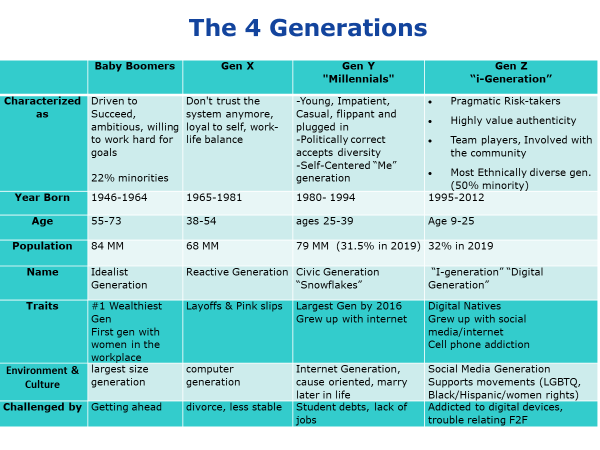
There are 4 major cohorts in today’s Marketplace, and it’s vital that you understand these generations and the changing buying patterns they bring. Here’s a quick snapshot of the essential features:

You can’t sell anything unless you understand your target market and who is doing their buying. This means understanding the environment they grew up in, the events that shaped their lives, their age, what they’re challenged by, and what’s important to them.
It’s also important to document the buying process at your key prospects. Oftentimes, you will find the actual buyer is a Baby Boomer or a Gen X, but the influencers are really Millennials or Gen Z. Typically, the busy executive will have “someone on their staff” research new products or directions and bring back a short list of what they found. If you are not influencing these younger influencers, you might never make the short list!

2. Unique Value Proposition

We don’t sell products anymore, and we don’t really sell benefits. The world has gone way beyond product details (unless you’re selling highly technical products). Buyers today are constantly asking “What’s in it for me,” or what will it do for my business and my bottom line. This means we need to shift our focus to the Unique Value of our product or service.
If there’s nothing unique about our product, we need to go back to the drawing boards and figure out WHY people are buying from us. Sometimes, the best way to understand your unique value proposition is to ask your buyers.

The key is to understand your UVP, and then BRAND your product with it. And for heaven’s sake make sure that you solve an actual problem for your customers. Don’t make the mistake of creating a “me too” product that doesn’t really solve a problem!

3. Marketing across Generations

If you understand the generations, you’ll appreciate something called “screen size.” Baby Boomers grew up with the television, and some of them were there when color screens were first introduced. They viewed the world through the lens of a television screen, and they received news on 3 major channels only.

Generation X (age 38-54) grew up with television, but increasingly their attention shifted to computer screens. First the desktop with an attached screen of varying sizes, then in later parts of the cohort this transitioned into laptop devices. The screen became smaller, and cable TV was introduced which expanded the number of channels.

Millennials (age 25-39) grew up with laptops and tablets, but their screen now included cell phones which now included email, texting, and web access as well as making phone calls. The screen size was now even smaller. And the next cohort, the sons and daughters of millennials (age 12-25) can seamlessly split their time across all 5 screens but are mostly focused on their cell phones. Indeed, 46% of their waking hours are spent peering at their cell phone screen, which is now leading to multiple medical problems and cell phone addiction (nomophobia).

If important for marketeers to understand their target market and concentrate their efforts on the best screen for their market. If you’re selling to Gen-Z, then you wouldn’t spend your marketing dollars on printed brochures or email campaigns! Conversely if your target market is baby boomers, you wouldn’t feature google ads or gaming consoles. You must match your marketing dollars to the correct screen!

4. Selling in the “New Normal”

Sales today occur at light speed. Buyers are demanding short, concise, value-based branding and gives them an instant WIFM (what’s in it for me). Everything today has accelerated, and you don’t have time for complicated messages. Keep it direct, simple, relevant, and compelling and don’t waste your buyers time!

5. Replace Cold Calling with Warm Calling

The years of cold calling or cold visits are pretty much over. In fact, one of my associates has written a best seller entitled “Never Cold Call Again,” (Frank Rumbauskas) in which he argues that cold calling is not only ineffective, but it damages credibility and drives away potential customers! My advice is simple: if you’re going to be using the phone for sales, make sure you are making “warm calls.” Research your prospects in advance, know their names and their company, and figure out a way to make the call valuable and not a waste of time. Pre-stage your calls by sending a text in advance (if you know their cell phone #), research them on LinkedIn, and try to get a warm referral from an associate or networking partner.

6. Deliver what they REALLY want at light speed

Speed of delivery is incredibly important. Customers are used to near-instantaneous results. They can order product and have it on their doorstep the next day (Amazon Prime), they can purchase and download movies and play them NOW, they can have groceries and products delivered by Wal-Mart or Target within minutes. They are used to near-immediate gratification and simple interfaces. If you have delays in your order fulfillment process, your customers will not tolerate it. Fix it!

7. Use Free as a Strategy

I can remember marketing a Presentation Skills training course for a bargain rate of $499 for an entire day of training. It was a killer price and always sold out in the past! But after renting a hotel room and filling it with 3 attendees (OUCH) I did my research and discovered that one of my competitors was offering a one-day class that same day in that same town for FREE!

The new selling strategy has evolved. Savvy marketeers are now enticing customers to try it out for free or nearly free, and then making their margins on upselling the next step. For instance, SalesForce.Com (the dominant CRM vendor) will happily give away a version of their CRM software to individual users. You can download it for free and use it if you like, and it works just fine. However, when you expand and want to add users or implement more advanced features of the software, you must upgrade (for a hefty fee).

On the retail side, visit Costco and cruise their aisles, and you can try dozens of samples. Of course, this drives huge incremental sales. Ergo Free as a strategy can really work!

8. Replace Selling with Influencing

Millennials and Gen-Z do not like the term “selling.” No one likes to be sold anything, but we all like to buy. The modern sales model uses a lot of “influencers” to generate brand awareness and buzz. Many influencers have hundreds and thousands of followers, and when they endorse a product (via Facebook, twitter, Instagram, or shapchat) it can lead to massive sales and profits.

One of the biggest influencers in social media today are performers. For instance, pop singer Selena Gomez (age 27 net worth $75MM) has 123 MILLION followers on Instagram! BTW, the last we checked her fee for simply mentioning your product in a post (implied endorsement) was over $1 MM.

Of course, you may not be able to afford a superstar endorsement, but your sales planning needs to include a strategy to attract influencers and get their support for your product/service.

9. Take advantage of Technology

Of course, make sure you’re taking full advantage of any technology at your disposal. Depending on your target market, divide your sales & marketing budget accordingly. There are huge benefits to be tapped into with social media, web design, social media marketing, gaming, virtual reality, and online advertising.

10. Hire a Gen-Z or Gen-Y

In order to fully implement technology, my best advice is to hire a Gen-Y (Millennial) or a Gen-Z for your marketing department. First job is to have them review your marketing plan for 2020 and tell you what’s wrong with it! They will not back off from their honest opinions, and they’ll probably give you some great advice.

You might have to bite your tongue and learn to tolerate a younger brash employee who expresses their opinion freely with no filter, but it will be worth it. Especially if you want to connect with a younger target market, it pays you to listen well.

So, there you are! 10 quick strategies for survival in the new decade. Good luck and let me know your success with these tips!

Permission is needed from Patrick McClure and Lighthouse Consulting Services, LLC to reproduce any portion provided in this article. © 2020

Patrick McClure is a senior sales consultant with Lighthouse Consulting Services, LLC as well as speaker, trainer and author who enjoys working with individuals and corporations to help them achieve maximum performance. He has dedicated his practice to helping others become more successful and specializes in sales training. To learn more and receive Patrick’s free newsletter, please email Patrick at patrick@lighthouseconsulting.com. Or call him at 310-453-6556, ext 415.

If you would like additional information on this topic or others, please contact your Human Resources department or Lighthouse Consulting Services LLC, Santa Monica, CA, (310) 453-6556, dana@lighthouseconsulting.com & our website: www.lighthouseconsulting.com.

Lighthouse Consulting Services, LLC provides a variety of services, including in-depth work style assessments for new hires & staff development. LCS can test in 19 different languages, provide domestic and international interpersonal coaching and offer a variety of workshops – team building, interpersonal communication and stress management.

To order the books, “Cracking the Personality Code”, “Cracking the Business Code” and “Cracking the High-Performance Team Code”, please go to www.lighthouseconsulting.com.